Skip to main contentSkip to footer

Services

Prototypes in three to eight days

Functional samples in the production material, not a substitute. Anyone testing an assembly has to be able to trust the part.
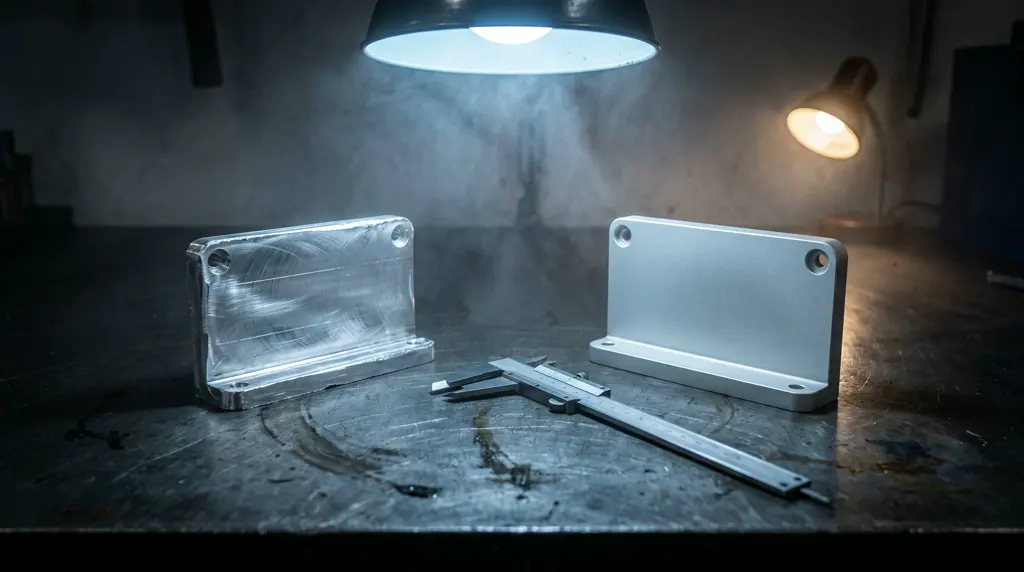
Two machined aluminium parts side by side: the prototype with visible tool marks on the left, the bead-blasted series part on the right.

What we do with it

A prototype in the wrong material answers the wrong question. A printed part tells you about envelope and assembly; it tells you nothing about stiffness, fatigue or sealing. We mill from the material the part will actually run in.

Two machines are deliberately kept out of the series schedule for this. They are not the most productive in the building, but they are the ones an urgent part can start on immediately.

From model to sample

  1. Feasibility in four hours

    We look at the model and say whether the date is achievable. That answer costs nothing.

  2. Straight from the model

    A STEP file is enough for a functional sample. Tolerances default to ISO 2768-f unless agreed otherwise.

  3. Milling

    On the reserved machines, overnight where the date demands it.

  4. Measure and ship

    A dimensional report on the critical features ships with it. Dispatch the day it is finished.

Machines used

  • Five-axis precision centre

    Small parts at the tightest tolerances. 42,000 rpm for tools under 3 mm, 1.5 µm positioning accuracy.

    Travel
    500 × 450 × 400 mm
    Axes
    5
    Units
    2
  • Five-axis machining centre, medium

    The workhorse. Housings, brackets and mid-size series parts, with twelve pallets for the night.

    Travel
    850 × 700 × 600 mm
    Axes
    5
    Units
    5
  • Three-axis machining centre

    Fixture building and simple prototypes. Deliberately outside the series schedule.

    Travel
    1020 × 610 × 610 mm
    Axes
    3
    Units
    0
See the machine park

Materials

  • Aluminium

    The default for lightweight parts and prototypes. 7075 where strength matters, 6082 for everything else.

    EN AW-6082 · EN AW-7075 · EN AW-5083 · AlSi10Mg

  • Titanium

    Ti-6Al-4V for aerospace and motorsport. Low cutting speed, high coolant pressure — expensive in time, not in tooling.

    Ti-6Al-4V Grade 5 · Ti Grade 2

  • Engineering plastics

    POM, PEEK, PA6G. Clamping is the real task here: the material yields where metal would stay put.

    POM-C · PEEK · PA6G · PTFE

  • Structural and tempered steel

    42CrMo4 tempered for loaded parts, 16MnCr5 for case-hardened. Distortion in hardening is planned for, not hoped away.

    S355J2 · C45E · 42CrMo4 · 16MnCr5

What we hold

  • 0.01 mmTrue position
  • 0.01 mmBore
  • 0.8 µm RaSurface

ISO 2768-f as standard, ±0.01 mm on declared fits. Tighter is possible but costs days rather than hours — on a functional sample that is rarely the right trade.

See quality assurance

Why here

  • Production material

    Same alloy, same heat treatment, same surfaces as the series will have.

  • The same supplier for the series

    The prototype runs on the machines that will run the series. The transition is a change of quantity, not of supplier.

  • Reserved capacity

    Two machines outside the series schedule. That is why "three days" is a commitment rather than a hope.

Used in

Common questions

How fast, really?

Three days for simple geometry in aluminium, eight for five-axis parts with heat treatment. We name the date before you order and we hold it.

What does a prototype cost?

Between €180 and €2,400 per part depending on material removal and setups. The biggest lever is not size, it is the number of setups.

How quickly can you turn a revision?

A second iteration of the same part is typically 40 % faster — CAM, fixture and setup already exist.

Do you print?

No. We cut metal. Where additive is the right answer we say so and name a partner.

Ask about a part

A STEP file is enough for a feasibility answer. It comes the same day.

Guided tour