Services
Five-axis simultaneous milling
Structural parts, housings and mould inserts cut from solid — up to 1,600 mm and 1,400 kg, in a single setup.
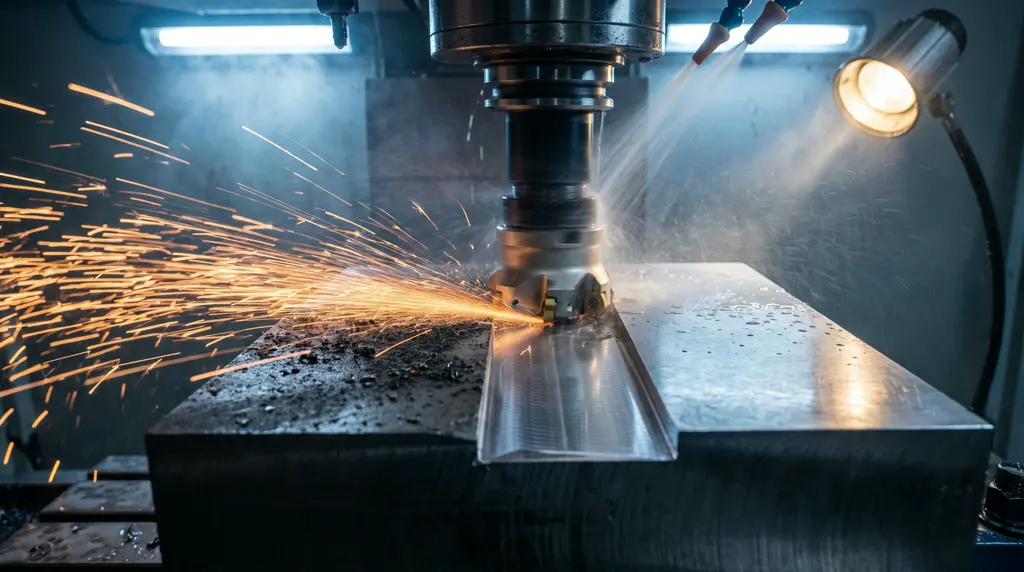
What we do with it
Five axes simultaneous means fewer setups. A structural part with pockets, angled hole patterns and a sealing face comes off in one setup, two at most — and every setup that disappears disappears as an error source with it. Positional error between two features is not created by the machine; it is created when the part is re-clamped.
So we plan the setup sequence before quoting, not after ordering. If a tolerance stack cannot be held across two setups, you hear that before you place the order.
From model to part
Manufacturability review
STEP and drawing read against each other. We mark what is expensive and propose what can be cheaper without losing function — radii, access, tolerances that need not be tolerances.
CAM and simulation
Toolpaths simulated including holder and machine collision. The first pass on the part is never the first pass.
Fixturing
Zero-point system, milled soft jaws where needed. Fixture repeatability 0.005 mm — below that the machine accuracy buys you nothing.
Roughing and finishing
Separate tools, separate paths, with a stress-relief step for parts with high material removal. A part that moves after roughing will not hold a finishing tolerance.
Measurement
First article measured in full on the CMM, then to the inspection plan. The report ships with the parts.
Machines used
See the machine parkMaterials
What we hold
These figures apply to aluminium and quenched-and-tempered steel at 20 °C. In titanium and nickel alloys we sit one step wider — not because the machine cannot, but because the material moves while it is cut. What is realistic on your part is something we tell you after seeing the drawing, not before.
See quality assuranceWhy here
Used in
Common questions
How large can my part be?
1,600 × 900 × 850 mm at up to 1,400 kg table load on the largest machine. Above that we place it — with the same inspection and the same accountability, but declared honestly as bought in.
Can you machine without a drawing?
Not from a 3D model alone. A model carries no tolerances and no surface callouts, and both drive the price. If you only have a sample, reverse engineering turns it into an inspectable drawing.
How fast is a quote?
Within 48 hours on complete documents. Complete means STEP, a drawing with tolerances, material, quantity and required date.
Do you make one-offs?
Yes, from quantity 1. On a single part the setup dominates the price — if you have geometrically related parts, quoting them together almost always pays.
What about heat treatment?
Through fixed partners, with measurement before and after hardening. Distortion is not hoped for; it is measured and planned into the sequence.
Send a drawing
STEP and PDF are enough. You get an answer on tolerance, quantity and date — not only a price.